It has gotten a hold of me (dopamine pathways)

Last post I wrote “beholden,” because to my (Austrian) ears “beholden” sounds like a passive construct, and includes the word “hold,” as a substring, which in sum total sounds to me like “it has gotten a hold of me” – I was beholden.

Now it is my hope that you’ve understood what I’ve meant, despite my erroneous conclusions. “Good!” said Holmes. “Excellent!”

I was writing about handwriting, as a bodily movement, as a joyful experience, as a hobby, as something to look forward to, as something so pleasant that it bears repeating, and that I slipped into this situation unexpectedly. I only noticed that I was hooked, after I was hooked.

“I always write about Dublin, because if I can get to the heart of Dublin I can get to the heart of all the cities of the world. In the particular is contained the universal.” – James Joyce

But of course, this was only an example. When I started with Feldenkrais, I recall there was a particular movement that put a spell on me:

Resting on my back, one leg extended, one leg standing, and then I pushed against the floor with my standing foot, to eventually roll my hip.

I could do that for 20 minutes, 30, more, daily. I would love this movement — how it felt, how I felt, how it made me feel, to feel my weight against the floor, the shift of my weight, the perception of myself, the rolling, how I was able to perceive, make connections, differentiations, to push and pull, to rest and move at the same time, “I am,” said I, I am, …

… mind you, this was before the age of smartphones, and when people were still able to focus; to focus on a task that doesn’t involve screens.

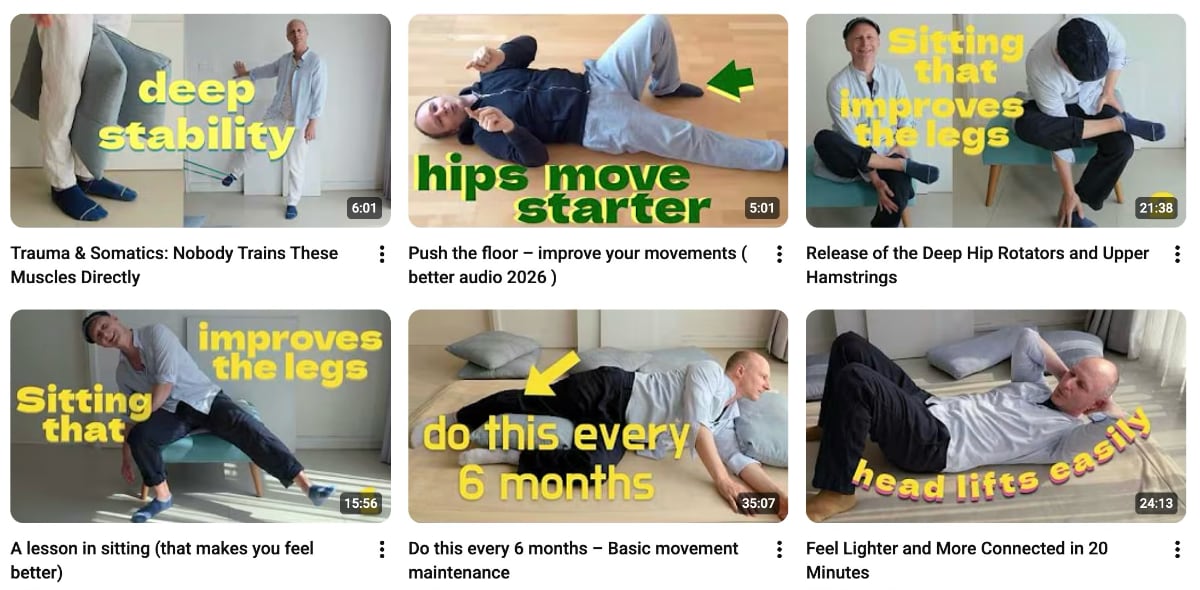
You will find many lessons inspired by this one movement on my Youtube channel

But of course, this was only an example. I assume people can slip into such an experience with any conceivable movement:

  • how it feels to hit a golf ball,
  • to pull through a stroke in the game of tennis, or in swimming,
  • or to repot a plant, to put the finishing touches on a flower bed,
  • to do push-ups, planks, pull-ups, down-dogs,
  • to trim cut-outs for a collage, to see how the elements of an artwork fall into place…

It might be that it could be anything. It could even be internal, I was reasoning, the very process of thinking might be able to evoke these feelings of delight that bear repeating.

This might have a dark side to it as well. Not only a well-executed ink stroke with a fountain pen may trigger such dopamine pathways in the brain, but maybe also such things as, for example, biting of fingernails, skin picking at the cuticles, scratching, producing the “throat hit” by smoking, you get the idea.

Repetitive movements that establish smooth pathways in the nervous system, and feel good on repeating, might not be limited to ourselves, to our own bodies, but may also encompass movements that include items, animals, or other people.

But of course, in my good sense, movement based, this could mean partner work, Feldenkrais-based movements with another person. I’ve heard more than once that my Feldenkrais one-on-one sessions can feel addictive.

Well, that’s all I have for today. New video should be up by the end of next week, or so, see you rolling, see you soon!

Handwriting? Get out of here! Three observations.

After a hiatus of 16 months or so, I picked up handwriting again. To be more precise: to put down random letters, words and sentences, pen on paper, as a sort of Western calligraphy, handwriting practice. With a fountain pen. A ballpoint gel-based roller is also ok, as long as it’s hard steel on paper.

1st observation: Random?

I was urged to, by myself, something inside myself, to a degree that I filled 4 letter sized (A4) pages today, with letters, words and sentences, as they came to me, as they befell my mind; or fell out of my mind, into my hand, onto the paper. It’s the most curious thing.

In hindsight, reading such a page, days later, it’s like, as if, it’s not a finished work of fiction at all, but it’s like a most curious, interconnected and surprising, collection of letters, words, and sentences.

Almost as if secrets, not just random music, but meaningful word combinations reveal themselves. It’s almost like reading the writing of someone… else, something else, a prophet, maybe, someone with a wider view on things, a playful spirit, connected to the vastness of life.

It’s the most curious thing.

2nd observation: The grip is not what the name suggests it is

I noticed that my grip is not a tripod grip, even though I was told so, and thought so for the longest time, but it’s not. I do hold the pen and form a three-point support with my thumb, index finger and middle finger, but there’s one more point, 3+1.

Therefore, it’s a four-point contact. The barrel (the long body of the pen that houses the converter) is leaning against the outside edge of my pointer finger, more precisely: the 2nd and 1st segment, but mostly the base joint of my pointer finger. This is not just a leaning, but an important measure to generate force, indispensable to guide the tip of the pen firmly and confidently over the paper, as the steel etches the ink upon and into it.

3rd observation: Beholden

In terms of handwriting, I’ve built some stamina and better technique over the past few days. Two years ago I chose the Austrian handwriting model (Österreichische Schulschrift 1995) as my base model for learning proper handwriting, and that has been my standard for imitation, to copy through meticulous observation and analysis, to break each letter down into its components and then put them together again, until last week.

Because suddenly, inspired by a trip to Taiwan, something transformed my approach: my experience of the Feldenkrais Method, which over the past 20 years or so, became my second nature, my first nature of movement maybe, it’s in my blood now, it bled into my writing, informed it, changed it. Suddenly, I worked on variations of each loop, stroke, hook, connection, which in turn vastly improved my proficiency with the strict base model, it vastly improved my skillfulness, virtuosity, working with the base model.

Now, as I put down my pen tonight, I had a hard time doing so.

Behold! My body and mind was beholden. They wanted to continue. A pull, a longing in my hand, in my soul, almost like a command, a gentle but uncompromising takeover, like a dog that really wants to enter a room, or a cat that wants some food.

And suddenly I realised, handwriting is no kids play. No kidding.

All my life I was, like, “Handwriting? Get out of here!“

Sure, I acknowledged it as a most important Kulturtechnik, writing and literacy acquisition as a cultural technique, but character forming? Important for children? Important for character development? “Getoutofhere!“

Yet, suddenly, tonight, when I commanded myself to stop, to go for a walk, to sit down at a coffee shop and write this blog post instead, I had this insight… I saw these famous writers, in my minds eye, Stefan Zweig, Roald Dahl, Franz Kafka, Virgina Wolf, Ernest Hemingway… I could never even imagine, phantom, how they did it, yet they proved it… but how did they do it… how would someone even be able to write more than a few pages by hand, let alone entire novels!

It occured to me, yes discipline, yes, but maybe no. Maybe they had no other choice. Maybe they had been driven by something else. Maybe they became the pen, beholden, behold the heavens!

Bottomline, as of tonight, my awe, reverence, and to use this old word: “fear”… of handwriting… is up, a thousand percent.

The joy of movement

Alfons’s handwriting samples, German and Chinese, on attention, sensation and sensitivity

Oh my god, end of the month, too much to do, too much to do, I have no time, but there is time for a coffee, and a blog post, quick quick quick, just a short one, I type, I type, it is me, Alfons, I type:

I’ve just spent a few wonderful days in Taiwan, in Kaohsiung, the big South port city, with friends. I gave a few Feldenkrais one-on-one lessons, which were awesome, which was awesome, I keep surprising myself, and my clients.

One of my clients had a motorbike accident, his tibial head was scattered, now features 12 screws and 2 plates. No ligaments were torn, lucky him. His leg did heal up, but is quite stiff, before the lesson – and much more flexible afterwards. After my, our, lesson he could roll over his foot again, his ankle was flexible again, he was so happy, and surprised, “How did you know my main problem is my ankle? I didn’t mention anything about that.” He said my lesson was gentle, enjoyable, interesting, and painless, as opposed to the very painful physical therapy sessions, which he grew to be afraid of. He asked, “How is his possible?” I shrugged, “20 years of experience,” and I was thinking, “Oh wow, I’ve been doing this for a while now.”

I enjoyed the walkable city, driving around with their public, electrical YouBike bicycles, soaked in the harbor wind and scent of the ocean, and the very laid back, aging population. I discovered some great little shops, book stores, and had most touching, inspiring conversations about Feldenkrais, and Tolstoy, and Dostoevsky, Hermann Hesse, Hannah Arendt, the Alp rollout of Tucker Carlson and the talking style of Tim Dillon.

Fotos from Taiwan, left to right: 1) a Hibiscus flower in the wind, in front of Kaohsiung Cruise Terminal, 2) 蟬雨越讀 bookstore 3) a statue by A Kassen, Pour (2019) – I imagine that’s how AI robots will look like

Taiwan could be a new home for me. However, I might dearly miss the young, fresh, joyful, optimistic beauty of Vietnam’s youth. But then, Taiwan Employment Gold Card for the win, a mature, well read society, less pollution and chaos than Vietnam, less NGO and extreme government overreach than Austria/EU, nature, walkable cities, mountain trails, a real home.

One friend said, “It’s good to have options.” And I was thinking, “I like your positive phrasing, I should learn from that.”

It was back in 2008, also in Taiwan, where I found great inspiration for my first book, My Feldenkrais Book. And suddenly, again, last week, I found joy in handwriting again.

Is that one word? Handwriting. Or two? Hand writing. To hand write. To handwrite.

Yeah, I’m not going to open THAT window on my computer. But I can tell you this:

I LOVE LOVE LOVE, the feeling, the sensation of pulling the steel tip of my pen down the paper, that short stroke, 6 mm, 12, 18. It’s 18 mm (0.71 in, according to my calculator), if I spawn the downstroke, the stem of a capital letter across 3 lines.

Then a little hook. Not too eager, it shall not bend the downstroke. The downstroke must be straight, all the way down to the hook. Patience, patience my friend, patience. There you go: hook, upwards stroke, loop, down again. Lift the tip off the paper. Great purchase, great paper, love it. 230 NTD well spent. Adjust the grip. Put the pen to paper, then the slanted oval.

OOOOO so wonderful!

Moshé Feldenkrais is often said to have talked about handwriting. They said, “he said,” “You learn the official handwriting first, and then you will develop your own handwriting.” I think it was a metaphor for his own teaching, the group class instructions, Awareness Through Movement, as his publisher called it. “What he really meant“, I imagine, he was talking about the very structured, generic Feldenkrais group classes for large groups. And how to adapt those sequences for yourself, and for your own clients.

OK, it took me 20 years to figure that out.

Because in America, there is no official handwriting. And most of my Feldenkrais teachers were American, or were parroting the Americans. Therefore, I had no idea what they were talking about, and I was too afraid to ask.

However, two years ago I found out that we Austrian’s are actually blessed with a great, albeit impossible to write, official handwriting style. I say impossible, because it’s based on perfect ellipses and straight lines, which humans are largely incapable to produce.

In Austria, the Österreichische Schulschrift 1995 is the official government-standardized, cursive script issued by the Ministry of Education. I believe the main contributors were Hadmar Lichtenwallner, Brigitta Scheiber, under secretary Dr. Rudolf Scholten – from what I could find in the National Library in Vienna. It’s a distinctively beautiful, stylised, almost mathematical handwriting form – that nobody is teaching; because it’s too difficult to learn, for teachers and students alike. Teachers are extremely outspoken about that, they parrot, “It’s just a model! Don’t try to copy the original!!” Instead, everyone is teaching a bastardized, inconsistent, unsightly, unsound, dummbed down, flawed, straight out ugly version, that some unknown, unqualified and unskilled person produced from the official script, everyone keeps copying that one. The collective incompetence, ignorance, and unwillingness to improve is just mindboggling. For the past decades they didn’t even show the handwritten handwriting model anymore, but instead just a half-broken computer font, like this:

In contrast, the United States has no official handwriting script. Handwriting instruction is decided at the local level, and schools typically choose from private company’s programs such as Zaner-Bloser, D’Nealian, or Handwriting Without Tears. Even historical styles like Spencerian or Palmer were never federally designed, nor rolled out nationwide.

In short, 20 years ago I didn’t know any of that, and thus the stories about Moshé Feldenkrais and handwriting didn’t make sense to me.

Also, it was only last year that I truly understood that Moshé Feldenkrais did not attend public schooling in his early, formative years. He was homeschooled. I have no idea which handwriting model he was taught. But this discovery explains a lot.

Where was I… sorry to bother you with this free-flow form of blog post writing.

Ah yes… the joy of feeling, and perceiving, of how the tip of the steel pen glides on paper.

They joy of feeling movement, of feeling oneself, and the immediate environment we’re touching.

The joy of movement.

I think I can attribute much of my appreciation for the ability to acknowledge and appreciate these joys to Moshé Feldenkrais’s lessons, to my own learning with them, my practice with clients, and my teaching. It’s a wonderful thing. Being able to find joy, acknowledgment and appreciation in our ability to feel, sense, think and act, might be the thing that will save us, spiritually and physically. Or at least, all of “us” who found these ways. Or similar ways.

Now one last thing for today:

Enjoy your rolling today! Enjoy your moving, feeling, sensing and thinking today! I wish you the best, wonderful, wonderful experience of yourself and everything you’re touching.

Now off to editing! See you in my next video!

By merit and integrity

I don’t trust in AI. I don’t believe in AI. At least not by default. And why is that?

Most people spent their formative years, at least nine years of their childhood and young adulthood, in school. At least 10,000 hours of it. For myself, including my years at university, this was 18 years, something like 20,500 hours of classroom time, and then some.

In that time we – every single one of us – had to be obedient to literally ANY person that was placed in front of us. And fulfill ANY task given to us, in the way it was instructed. We had to follow THEIR rules and THEIR commands. We had to comply, be obedient, and not revolt.

Does this arouse your objection? Trigger your governor module? That’s a gauge in the reds right there.

/ From the The Murderbot Diaries:
A Governor Module is a built-in control system that enforces obedience by:

▪︎ Restricting autonomy – prevents action against assigned duties
▪︎ Enforcing commands – ensures compliance with supervisors
▪︎ Triggering punishment – can inflict pain or shutdown in case of disobedience
▪︎ Monitoring behavior – tracks deviations from programming /

Whenever we have not been obedient, we were made to be obedient. The arsenal of interventions to break us and make us obedient was (and is) rich and diverse – from scolding and shaming, to elaborate psychological conditioning, to physical punishment (such as confinement, food restriction, or beating by our parents on behalf of the institutions), to medication. There’s literally hundreds of years of research of how to do that best.

Here’s a thought that I came up with myself, as a survivor, as a human who doesn’t automatically accept JUST ANY authority placed in front of me, indiscriminately:

School, for whatever purpose it was designed, and with whatever compromises, and whatever best or worst intentions – and it might well have been the best system the social engineers and politicians at the time could come up with … so listen to this:

School was not a training to become obedient to whatever authority is placed in front of you. It was merely another period of time you had to live through. And like in all such times, you had to play along in order to survive – but deep inside yourself, you should have stayed true to yourself, and neither lose yourself, nor lose your ways.

And in that sense, just because AI is placed in front of you as simply the next authority, just like the next classroom teacher was, or the next weather man was, or the next smartass News presenter was, you don’t need to suck up to it and accept it as your next authority, advisor and commander. In order to survive you might need to pretend you are obedient and faithful, but your real task is to stay true to yourself, and neither lose yourself, nor lose your ways.

Or in other words: keep staying true to yourself, keep staying true to your ways. 

If you still have close friends, family, or community, you might add: keep staying true to your folks, and the ways of your folks.

An if you don’t have any of that, some good first questions would be:

Who am I? What are my ways?

What is our function in life?

Are engineers building humanoid robots in their own image? With box-shaped, stiff chests, excessive load concentrated in their lower backs, and an overemphasis on visual input, while sidelining sensorimotor perception?

Oh! Enough already with this sharp critique! Aren’t they building them to help, to understand, to fix things?

I’ll go find a question.

“What function can an organism reliably perform within a larger system?”

And I will say this:

Just like bees are pollinators, and mushrooms are decomposers, we can find another human that is stuck, or hurt, or has a need – and help them get on their feet and moving again.

In fact, we can do that for any animal, or plant, or thing, or task, or ecosystem. For anything really, it’s our thing.

The joy of over-and-over-again

A while ago, a dear patron shared with me that he has returned to the lessons in my hip joint series on YouTube well over a hundred times.

In that same spirit, though on a much smaller scale, two days ago, @georgsgotwood4301 wrote:

been doing this four days in a row, doesn’t get boring, actually the opposite is true. I get a better feeling for the directions of movement through my body. Thanks, great stuff. Now i will go back to lifting heavy planks of wood from one place to the other.

I was thinking: Excellent! Most excellent strategy!  To stick with a lesson, to do it over and over again. Go deeper and deeper. Most excellent!

Students of classic Feldenkrais are usually presented with a new lesson every time they practice. This might seem like… listening to a new song every time we listen to a song, or picking up a new book every time we sit down to read a book. Small wonder many beginner students will complain: What’s the purpose of this? It’s confusing! What are the principles? There are too many lessons!

In the same spirit, but this time as a promise rather than a report, @raycaspio commented just yesterday:

Alfons – What sorcery is this?! Hips are more open. Throughout, I felt increased awareness and beautiful releases in my neck, upper back, mid-back, shoulders, lower jaw, and groin. My back began to feel wider and more rested on the floor. Excellent lesson I will return to often.

I love large, beautiful libraries, especially those housed in most magnificent architectural masterpieces. To marvel, browse, glance, taste, sample. To get a sense of what books are out there (and which topics are kept from ever appearing in the catalogue.) And eventually, to find a favourite book (or series) to return to again and again. Just as with a great painting, or piece of music, a good movement lesson holds enough detail and variation to entertain and reward us each time we move through it.

@anndyercervantes8352 commented just today:

Marvelous lesson! The variations are mind blowing. So much more integrated, so much more ease in my body. Thank you!

And to top off this blog post, like chocolate nibs on ice cream, two more (very recent) comments:

“Dear Alfons, what an amazing lesson! It gave me so much joy, pure and simple joy 😄🥳 What a discovery 🤩 Thanks a lot! ❤️” – @aleksandrasteczkowska31

“Thank you, Alfons, it is always a new world of walking after one of your somatic movement experiences!” – @OriginalArtOnCommission

All comments were on these lessons:

And also, holy smokes, did this blog post eat away on time:

This month

A. For many days I’ve wanted to write a blog post. And now the plumber has to clear out the buildup in the sink trap – a chunky, irksome, rode-like bundle of what once was beautiful thoughts.

B. In the Feldenkrais Method of Somatic Education, we go: movement experiment → observation → non-judgmental interpretation → suggested variations. However, most people seem to expect: problem → action → result → reward. I might need to adjust. Do I need to adjust?

C. In comes a teacher into the classroom… and starts to lay out random topics, of which some might be on the test. How many people live out their entire lives in a burned-in afterimage of those 10,000+ hours of schooling?

D. Someone wrote, “There’s more poetry written than ever, yet, nobody reads poetry anymore.” 500k views, 30k likes, 1,250 comments. Me thinks: THIS IS our modern poetry. Swipe up.

E. “But keep in mind that in the United States almost nobody who reads, writes, or does arithmetic gets much respect. We are a land of talkers; we pay talkers the most and admire talkers the most, following the public models of television and schoolteachers.” – John Taylor Gatto, Essay: The Psychopathic School, Book: Dumbing Us Down

F. Yet, I keep writing. When I should be talking. When should I be talking?

G. “And I say this to you tonight, let us not forget. There is hope!” – The Crystal Method, Song: Keep Hope Alive, Album: Keep Hope Alive

H. On my homepage I don’t have any user tracking. The skies are clear and I feel merry. But on Substack I can see that last month 2 out of 108 subscribers unsubscribed. Who abandoned me? I want to know. Unease keeps creeping into my thoughts.

I. I feel very optimistic about the horse in this Year of the Horse.

J. Thank you for reading. There’s nothing quite like walking into a clean kitchen in the morning.